Monday, July 30, 2007

Rocket State

This is essential viewing, especially after reading Seamus' post from last October. Hilarious stuff... A great little movie.

Labels: , , , , , ,

IR-IKU SINIFI

Some footage of our fellow international relations students in Turkey. A few of the folks in the class that graduated in 2005 made a video. Here is one of their descriptions:

"In 2005, I and my class were graduating from the university. I made two VCDs as a memory of university days and dealed them to my friends... I won't upload them to YouTube. However, I just wanted to make you watch the intro of the discs, because it is a summary of our university days and everybody in our class, except 2 persons which don't want to be shown in YouTube amd many lecturers of us, can be seen in this video. The music is composed by Melih Kibar and first used in the most famous Turkish comedy movie "Hababam Class"... Our class was called "IR-IKU Class 2000/2005"... IR means "International Relations", IKU means "Istanbul Kultur University"... I hope you'll enjoy this video..."

Labels: , , , , ,

Sunday, July 01, 2007

Some light reading on political Islam

I'm about halfway through Islam and the Myth of Confrontation: Religion and Politics in the Middle East by Professor Fred Halliday. Halliday is originally from Dublin, and lectures about the Middle East in the London School of Economics. I usually read his column on Open Democracy, which gives a great analysis of events in the region.
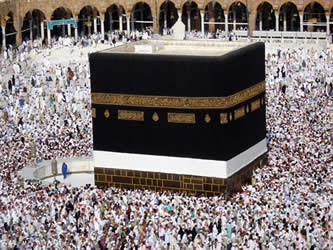
Mecca

Political Islam is the use of Islam in the realm of politics. Actors who subscribe to this philosophy are known as Islamists. As well believing that Islam should be the basis of a political system, Islamists use the Muslim faith as a tool of popular mobilisation, and as the means to express political and social ideas in a religious language.

One of the academic questions that often comes up when studying political Islam is that of civilisational values. There are those who believe that we are currently in a situation where there is a 'Clash of Civilisations' between Islam and the West. Halliday is among those who suggest that the rise of political Islam in the Middle East and North Africa is linked to Western policies in the region, rather than some kind of essential Islamic values. He identifies political Islam as being essentially problem-driven in nature. According to this understanding, Islamist actors are responding to perceived social and political problems in the region, rather than some kind of hatred for the West.

Because Islamists are attempting to provide solutions to problems, Halliday believes that "the issue of development... is a useful starting point" (p. 128) in understanding political Islam. Halliday agrees that the region is faced with significant social problems. However, he doesn't have much faith in the potential for the Islamists to come up with effective solutions, making reference to "empty ideas about 'Islamic economics'". I do not fully agree with his dismissal of the credibility of political Islam. It seems to me to be too soon to tell whether the Islamists would provide any real answers if they were able to gain power.

Ayatollah Khomeini

One of the strengths of Halliday's analysis is his emphasis on the variety of political Islam. He demonstrates that it is the specific context of the political situation in different countries that explains the actions of Islamist actors. Therefore, for example, the Palestinian Islamist movement, Hamas, can only be understood in the context of the Israeli occupation and the realities of life in Palestine. And the course taken by the Iranian revolution was influenced by the conditions during the Pahlavi dynasty. Thus political Islam should be understood as the result of a particular social and political context, and cannot be explained by reference only to qualities inherent within the Islamic religion.

One of Halliday's main points in the book is that the Middle East does NOT need to be studied using some unique category of explanation. It should be possible to study the region using the same analytical tools you would use to study any other area of the world. Halliday rejects the view that the only categories that can be used to describe Muslim societies are categories that are specific to the region; for example, that categories such as Marxism or Weberian sociology should be rejected in favour of authentic, local, often Islamic concepts.

Halliday can speak some Persian and Arabic and has a direct knowledge of the region. His particular area of expertise is Iran, and he devotes an entire chapter of the book to the Iranian revolution. I'd highly recommend this section to anyone with an interest in Iran. He has also met with Hizbollah's senior political strategist Sheikh Naim Qassem in Beirut.

Labels: , , , , , , ,

Tuesday, February 20, 2007

The Islamists - our new friends?

If you are taking the Political Islam course or generally interested in our southern and south-eastern neighbours then you might find the latest issue of the CEPS* European Neighbourhood Watch useful. It contains an interesting editorial on a developing dialogue between Islamist groups in the Middle East and North Africa on the one hand and European policy oriented NGOs and think tanks on the other. A number of things are interesting about this, notably the way the dialogue bypasses the governments of Europe and the Middle East, both of whom have decided that the only good Islamist is a severely repressed Islamist. But it is also interesting in its frankness about the fundamental existential questions that divide the European outlook from the Islamist one. The newsletter also contains a piece by Dr. Saad el-Deen al-Katany, the parliamentary leader of the Muslim Brotherhood in Egypt in which he sets forth the need for dialogue between Islamists and the West.

If you are not interested in political Islam or the Middle East, the newsletter also reprints an interview with President Lukashenko of Belarus, one of world's great scary leaders.

You can download the newsletter here: CEPS European Neighbourhood Watch

*Centre for European Policy Studies

Labels: , , , ,

Saturday, November 18, 2006

US client state in revolt?!!?

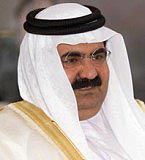
Qatar is a small state in the Arabian peninsula. I don’t know much about it – it’s an oil reliant country, and is a monarchy under a fellow known as Sheikh Hamad bin Khalifa Al-Thani. I also had always thought of it as one of a number of US client states in the region.

So I was surprised to see on some 24 hour news station or other (it might have been the BBC) that Sheikh Hamad was speaking out on behalf of Hamas. He basically called the US on their hypocrisy. They’re supposedly involved in democratising the Middle East, but when Hamas were elected they were dismissed as terrorists, and the US refused have anything to do with them. This is despite the fact that the EU called the Palestinian elections ‘free and fair’.

Sheikh Hamad of Qatar


This didn’t fit with my image of Qatar. At first I thought it might have had something to do with the recent US elections, but I discovered that the same Sheikh had spoken out in favour of Hamas in February. Good for him, I say.

To me, it seems pretty straightforward that isolating Hamas, and denouncing them as terrorists, will only serve to radicalise Palestinians more and more. Despite Hamas’ rhetoric about demanding the destruction of Israel, the reality is that they would be willing to begin the process of moderating their position in negotiations with Israel. In any case, the so-called prisoners’ document implicitly recognised Israel (haven’t time now, but I plan to give more sources for this stuff later).

The very process of interacting with democratic structures will put more pressure on Hamas to moderate its position and become less hardline. So, if the US discourse about democracy was genuine, they would be encouraging Hamas’ engagement with democratic institutions. This goes for any state, including Iran. The US approach to Iran, in my view, is likely to either marginalise or radicalise any moderate actors within Iran, when they should be nurtured and encouraged.

As far as I’m concerned, all of the rhetoric about democracy in the Middle East is a red herring, and any claim by the US that their intentions are benevolent has no legitimacy. In any case, I’m interested in this Qatar-ish head of state’s stance on the issue. Maybe he’s a critical theorist...

Labels: , , , , ,